Dissolved CO2 vs. pH vs. Conductivity: What's Your Water Monitoring Blind Spot?
Dissolved CO2 vs. pH vs. Conductivity: What's Your Water Monitoring Blind Spot?
Most industrial water monitoring programs run on a quiet assumption: pH tracks the chemistry, conductivity tracks the dissolved load, and between the two, the process stays inside its operating window. That assumption holds while water quality and process load stay stable. It stops holding the moment alkalinity shifts, aeration efficiency drops, a membrane begins to foul, or fish in a stocked tank come under stress — and it usually stops holding before anyone notices, not after.
This guide is written for industrial buyers who have to choose between complementary parameters for process control, not for buyers shopping for a single probe. It compares dissolved CO2, pH and conductivity as three measurements that look equally familiar on a control panel but carry very different diagnostic weight in practice. It covers what each measurement detects, what it structurally cannot see, what it takes to keep it reliable, and — the part most procurement documents skip — when an online multi-parameter water quality sensor should replace three separate installation points instead of becoming a fourth one.
Problem Definition: A Blind Spot Is Not a Missing Sensor
A water monitoring blind spot is not the same thing as an unmeasured parameter. In industrial practice, blind spots appear in four distinct forms, and only the first one is solved by buying more hardware.
- Unmeasured but controlling. A parameter drives the process outcome but has never been instrumented — dissolved CO2 in an aerated basin is a common example.
- Measured but misread. The signal exists, but the operations team interprets it as a standalone number rather than as one variable in a coupled system.
- Measured in the wrong place. The probe is installed where the water is not representative of the process stream being controlled.
- Measured but not acted on. Data reaches a controller but not a decision — no alarm, no interlock, no trend review.
The comparison in this article addresses the second and fourth forms directly, because pH, conductivity and dissolved CO2 are almost never wrong on their own terms. They become wrong when a buyer treats them as interchangeable evidence of water condition. A conductivity reading of zero tells you nothing about whether a boiler loop is protected. A stable pH reading does not confirm that dissolved CO2 has been stripped out of an aeration basin. Each of the three measures a different physical property, and each one goes dark on a different failure mode.
Industry Background: Why Parameter Coverage Now Outranks Sensor Count
The commercial context behind this problem is a market that is still expanding quickly, and an instrument architecture that is shifting at the same time.
The global water quality sensor market was valued at USD 5.74 billion in 2024 and is projected to reach USD 9.10 billion by 2030, growing at a compound annual growth rate of 8.1%, according to Grand View Research. Within that market, Asia Pacific held a revenue share of 46.5% in 2023, with China identified as a major increasing market. Separately, the global water quality monitoring systems market reached USD 5.8 billion in 2024, with sensors accounting for the largest segment at a 45% share. IoT-enabled water quality management is expected to grow at 16.23% CAGR through 2030, according to TechSci Research.
Those figures describe demand volume. The more useful signal for a procurement team is the direction of the architecture. IoT-enabled monitoring growth implies more distributed measurement points feeding a smaller number of integration nodes — which is precisely why the choice between three single-parameter probes and one multi-parameter assembly now has cost and reliability consequences, not just convenience ones. Conductivity, pH and dissolved CO2 sit at the center of that decision because they are commonly specified together for process control, yet they are usually bought separately.
Regulatory pressure reinforces the same trend. Industrial water quality sensors must comply with EN IEC 61326-1:2021 for electrical equipment for measurement, control and laboratory use — a standard that governs EMC behavior rather than measurement performance, and one that buyers increasingly use as a minimum qualification filter. For drinking water applications, NSF/ANSI 61 and 372 standards are critical certifications covering material safety and lead-free compliance.
Detailed Solution: What Each Parameter Actually Contributes
Dissolved CO2: The Parameter Most Often Missing From the Panel
Dissolved CO2 sits behind the carbon balance of a water system. In aerated biological processes, aquaculture systems and certain industrial process water loops, CO2 accumulates to a level that affects biological performance or process stability — yet in most installations it is not an online measurement at all. It tends to be discovered through offline grab samples after a batch fails or an alarm trips, which means the data arrives after the decision should have been made.
KACISE addresses this measurement with the KWC-100C Online Infrared CO2 Meter, which measures CO2 across a 0–5000 ppm range with customizable range options. The instrument provides an isolated RS485 output, optional 4–20 mA output, relay alarm, password management and menu-prompt operation. The relevant procurement point is not the measurement range itself but the interface set: an isolated RS485 output and a relay alarm allow the CO2 channel to be wired into the same control architecture as the pH and conductivity channels, rather than living as a standalone display.
The KWC-100C is specified for aquaculture, urban sewage treatment plants, electric power, water supply, medicine, chemical and food industry applications. Those industries share one characteristic: biological activity or gas transfer is a primary process variable, not a background condition.
pH: The Most Trusted Signal and the Most Easily Misread
pH is the most widely deployed water quality measurement, and it is also the one most often treated as a proxy for overall water condition. That is where the misreading starts. pH tells you about acid-base balance at the electrode surface. It does not describe dissolved ion load, it does not describe gas content, and it is temperature-dependent by nature — which is why automatic temperature compensation appears across the KACISE pH range rather than as an optional extra.
KACISE offers three pH paths depending on installation context:
- KDM-100 Online pH Meter — online pH measurement with temperature compensation, data output and alarm function. Specified for water treatment plants, drinking water distribution networks, aquaculture, food processing, chemical industry and pharmaceutical industry.
- KWS-790 Digital pH Sensor (IoT Supported) — pH 0.00–14.00 with ±0.02 pH accuracy, temperature range 1–100.0 °C (working range 0–60 °C), RS485 and 4–20 mA dual output, Pt1000 automatic temperature compensation, mobile app and PC debugging, IoT compatible, two-point calibration, high corrosion-resistant composite material, IP68. Specified for wastewater treatment, purified water, circulating water and boiler water, electronics, aquaculture, food, printing and dyeing, and environmental monitoring.
- KWS-750 Online pH Probe — pH 0–14, temperature -5 to 65 °C, working pressure below 0.2 MPa, POM wetted parts, IP68, built on a patented pH probe design with slow reference solution seepage, RS485 (Modbus/RTU) output, 3/4 NPT thread.
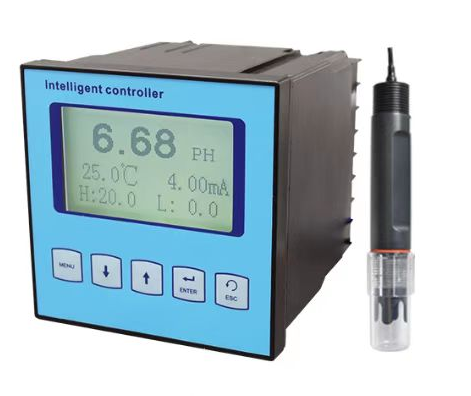
In a three-parameter comparison, pH is the parameter that tells you the fastest that something changed, and the least about what changed. That asymmetry is the reason it should be read alongside conductivity and, where relevant, CO2.
Conductivity: The Fastest Indicator of Incoming Water Change
Conductivity measures the ability of water to carry an electrical current, which in practice means the concentration of dissolved ionic species. Its value in process control is speed and breadth: conductivity shifts immediately when feedwater quality changes, when a membrane starts passing ions, or when chemical dosing drifts out of balance.
The KACISE KWS-350 Online Conductivity Sensor covers three measurement bands in one instrument — low conductivity at 0.01–200 µS/cm, medium conductivity at 0–5000 µS/cm, and high conductivity at 0–200 mS/cm — with a temperature range of 0–60 °C. It provides automatic temperature compensation, RS485 (Modbus) output, optional 4–20 mA, an anti-fouling design, and one-point or two-point calibration. The wetted construction is POM plus 316L stainless steel, with titanium available as a customization. Its specified applications include pure water and ultrapure water detection, drinking water monitoring, industrial process water, sewage treatment, electronic manufacturing and the pharmaceutical industry.
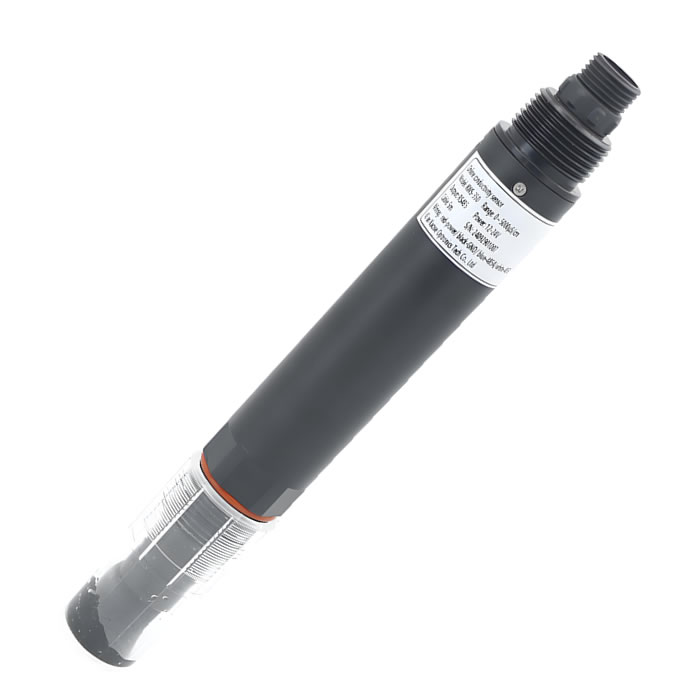
The band structure matters for procurement. A buyer specifying a single conductivity sensor for a plant that runs both a pure water loop and a wastewater stream is specifying two different instruments in one purchase order. The KWS-350 covers that span, but the range selection still has to be declared at order stage.
Where Each Measurement Goes Dark
None of the three parameters is redundant, and none is sufficient. The failure modes are specific:
- Conductivity sees ions, not species. It responds to total dissolved ionic content without distinguishing chloride from nitrate from hardness. A rising conductivity trend tells you something entered the water; it does not tell you what.
- pH sees acid-base state, not load. A well-buffered system can hold a stable pH while dissolved ion content and gas content change materially underneath it.
- Dissolved CO2 sees the gas balance, not the ionic balance. It responds to carbon transfer and biological activity and says nothing about scaling or corrosion potential driven by dissolved solids.
Step-by-Step Breakdown: Choosing the Right Parameter Set
The following sequence reflects how the three parameters should be evaluated before a purchase specification is issued.
- Identify the control decision each parameter would serve. A parameter that does not change any operating action is data, not control. If no one would adjust aeration, dosing or draw-off based on a CO2 trend, that channel is not yet justified.
- Map each candidate measurement to a failure mode you have actually experienced or expect. Conductivity for feedwater variation and membrane integrity; pH for chemical dosing and disinfection performance; dissolved CO2 for aeration efficiency and biological activity.
- Confirm the physical installation can produce a representative reading. pH and conductivity probes need wetted contact at a point where the stream is mixed. The KWS-750 pH probe, for example, is specified with 3/4 NPT thread and a working pressure below 0.2 MPa, and the KWS-350 conductivity sensor is built in POM with 316L stainless steel, with titanium available for more aggressive media.
- Verify signal compatibility before comparing price. RS485 (Modbus) output appears across the KACISE range, with 4–20 mA available on several models and dual RS485 plus 4–20 mA on the KWS-790 pH sensor. Mixed protocols are a hidden integration cost.
- Quantify the maintenance burden per parameter, not per probe. Anti-fouling design on the KWS-350 conductivity sensor addresses scaling on the electrode surface, while the KWS-750 pH probe relies on a patented design with slow reference solution seepage. Different maintenance profiles belong in the same spreadsheet as purchase cost.
- Decide integration architecture last. Only after the parameter set and maintenance profile are known should the buyer choose between discrete probes on separate transmitters and a consolidated controller or multi-parameter assembly.
Use Cases: Six Application Profiles
Municipal Wastewater Treatment
A wastewater plant watching effluent quality needs pH for chemical and biological process control and conductivity for influent variation. Dissolved CO2 adds value specifically in aerated biological stages, where carbon transfer reflects biological performance. A documented KACISE installation at a municipal wastewater plant in the United Kingdom used 12 sensors for effluent quality monitoring over a three-year period, with multi-parameter integration and reduced manual sampling as the recorded outcome.
Aquaculture and Fish Farming
Aquaculture is the clearest case for combining all three parameters, because biological performance responds to pH, salinity-driven conductivity and dissolved gas balance simultaneously. A KACISE installation at an aquaculture farm in Norway deployed 15 units for dissolved oxygen and ammonia monitoring over three years, with saltwater-resistant continuous monitoring and increased fish survival rate recorded. The KWC-100C CO2 meter and the KWS-350 conductivity sensor both list aquaculture among their specified applications.
Pharmaceutical and Purified Water Systems
In purified water systems, conductivity is the primary release parameter and pH provides supporting evidence of system condition. A KACISE installation at a pharmaceutical plant in Switzerland used 12 units for purified water conductivity monitoring over five years, with sanitary clamp connection and GMP compliance achieved as the recorded outcome. The KWS-350 conductivity sensor is specified for pure water and ultrapure water detection and for the pharmaceutical industry.
Potable Water Supply and Distribution
Drinking water networks rely on pH for corrosion control and disinfection performance, and on conductivity as an early indicator of source water change. The KDM-100 Online pH Meter is specified for water treatment plants and drinking water distribution networks, while the KWS-350 covers drinking water monitoring. For any sensor in contact with drinking water, buyers should confirm material safety and lead-free compliance expectations under NSF/ANSI 61 and 372 standards during qualification.
Industrial Process Water and Boiler Loops
Circulating water and boiler water require conductivity to track dissolved solids and pH to track treatment chemistry. The KWS-790 Digital pH Sensor lists purified water, circulating water and boiler water among its applications, and pairs an RS485 and 4–20 mA dual output with IP68 construction and Pt1000 automatic temperature compensation.
River, Lake and Environmental Monitoring
Environmental stations typically need the broadest parameter set and the longest unattended intervals. A KACISE installation at a river environmental monitoring project in the United Kingdom used three units for pollution detection and early warning over two years, recording stable real-time monitoring, improved response speed, remote IoT monitoring and low maintenance.
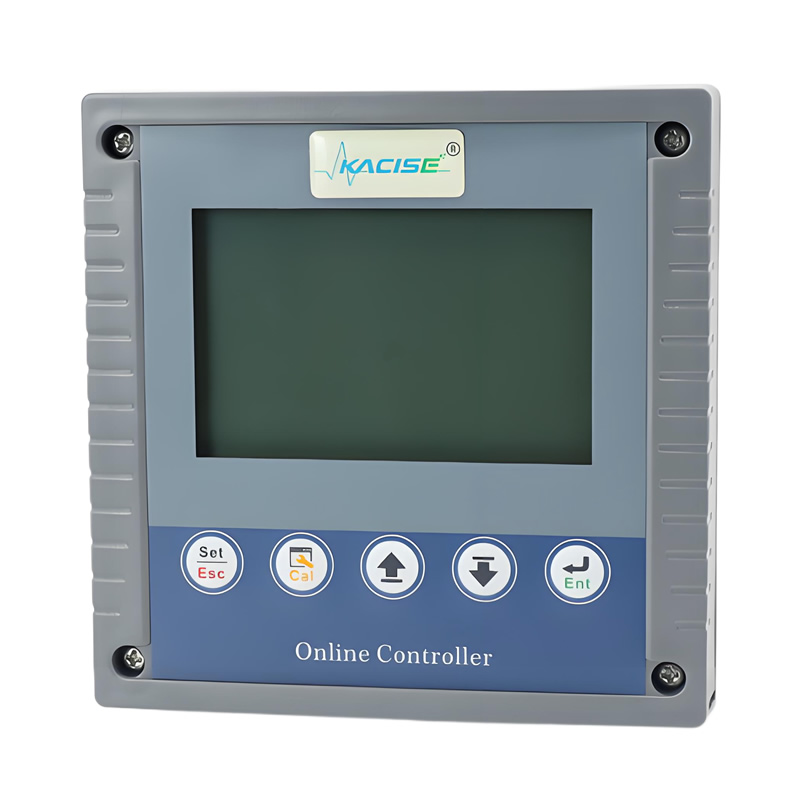
Comparison Table: Dissolved CO2, pH and Conductivity Side by Side
| Parameter | What it measures | Primary control decision it supports | What it structurally cannot see | KACISE model reference |
|---|---|---|---|---|
| Dissolved CO2 | CO2 concentration in water, measured across a 0–5000 ppm range with customizable range | Aeration and gas-transfer performance; biological activity in aerated or stocked systems | Dissolved ion load, scaling potential, species composition | KWC-100C Online Infrared CO2 Meter |
| pH | Acid-base state, with automatic temperature compensation | Chemical dosing, disinfection performance, process compatibility | Total dissolved solids, gas balance, non-ionic contaminants | KDM-100 Online pH Meter; KWS-790 Digital pH Sensor; KWS-750 Online pH Probe |
| Conductivity | Dissolved ionic content, in three bands from 0.01 µS/cm to 200 mS/cm | Pure water quality, salinity, feedwater variation, membrane integrity | Which ions are present; non-ionic pollutants; gas content | KWS-350 Online Conductivity Sensor |
| Decision factor | Dissolved CO2 | pH | Conductivity |
|---|---|---|---|
| Signal output | Isolated RS485; optional 4–20 mA; relay alarm | RS485 and 4–20 mA dual output on KWS-790; data output and alarm on KDM-100 | RS485 (Modbus) output; optional 4–20 mA |
| Wetted construction | Specified for aquaculture, sewage treatment, power, water supply, medicine, chemical and food industry contexts | KWS-750: POM wetted parts; KWS-790: high corrosion-resistant composite | POM plus 316L stainless steel; titanium customizable |
| Ingress protection | Controller-level installation | IP68 on KWS-790 and KWS-750 | IP68 on the probe assembly |
| Temperature compensation | Automatic temperature and pressure compensation available at controller level | Pt1000 automatic temperature compensation | Automatic temperature compensation |
| Calibration approach | Configured through the controller interface | Two-point calibration on KWS-790; two-point calibration on KWS-750 | One-point or two-point calibration |
When One Multi-Parameter System Beats Three Separate Probes
Three discrete probes mean three installation points, three cable runs, three controller inputs and three separate maintenance schedules. Consolidation makes sense when the parameters are measured in the same water body, at the same depth and under the same temperature range — which is the normal case in aeration basins, aquaculture tanks and environmental stations, but rarely the case when pH is measured on a pure water loop and conductivity on a wastewater stream.
Four KACISE integration options cover most consolidation scenarios:
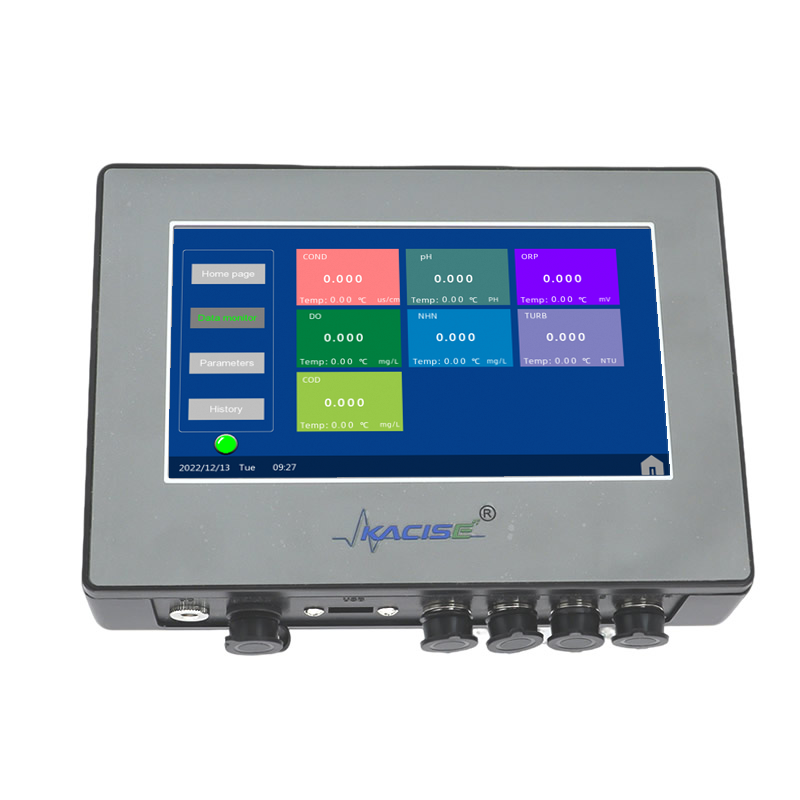
- KMPW520 6-in-1 Water Quality Analyzer — six freely combinable parameters including pH, ORP, COD, BOD, residual chlorine and turbidity, with a 7.0-inch color touch screen, two-channel 4–20 mA, six-way relay, two-channel RS485 (Modbus-RTU), TF card and USB data storage, historical curves and password protection. Specified for environmental protection, sewage treatment, thermal power, aquaculture, food processing and tap water online monitoring.
- KMPW400 Online Multi-Parameter Controller — real-time multi-parameter display on a 7-inch LCD touch screen, RS485 (Modbus RTU), automatic sensor identification, 60 days of data storage, DTU interface and USB port. Specified for surface water, municipal sewage, industrial wastewater, waterworks and aquaculture.
- KWC-100 Multi-Parameter Water Quality Controller — multi-parameter detection including COD, ammonia nitrogen, DO and pH, with automatic sensor identification, 4–20 mA isolated output, RS485 output, two-way relay and automatic temperature and pressure compensation.
- KWS-800 Online Multi-Parameter Water Quality Monitoring System — up to seven optional parameters (fluorescent DO, 4-electrode conductivity, fiber turbidity, digital pH/ORP, chlorophyll and oil in water) plus temperature, with RS485 (Modbus), an automatic cleaning device, waterproof connectors and an all-in-one design in titanium alloy and 316L stainless steel with IP68 protection.
The selection logic is channel capacity against parameter count. A KMPW520 supports six freely combinable parameters with six relays; a KMPW400 provides a wider display and 60 days of local data storage with a DTU interface for remote transmission. Neither choice changes the measurement physics of pH, conductivity or dissolved CO2 — what changes is how many panel positions, cables and calibration events the facility manages.

Frequently Asked Questions
What certifications apply to KACISE water quality sensors, and for which markets?
KACISE water quality sensors hold CE EMC certification for the EU market, certificate number ZTS23061509TCE, issued on 21 June 2023 by Shenzhen ZTS Testing Service Co., Ltd. The covered standards are EN IEC 61326-1:2021, EN 55011:2016+A2:2021, EN IEC 61000-3-2:2019+A1:2021 and EN 61000-3-3:2013+A2:2021. EN IEC 61326-1:2021 is the standard that applies to electrical equipment for measurement, control and laboratory use, which is the category most industrial buyers use as a baseline qualification filter. For drinking water contact applications, NSF/ANSI 61 and 372 are the relevant material safety and lead-free compliance standards and should be verified against the specific project specification.
Can KACISE customize outputs, protocols and cabling for a multi-parameter configuration?
Yes. KACISE operates under OEM and ODM production modes with customization covering voltage, logo, output method, protocol, cable and related parameters. Documented monthly capacity for the OEM/ODM line is 5,000 units, with quality control recorded as 100% test. A separate documented production configuration lists OEM customization for voltage and logo with monthly capacity of 8,000 units. This matters for consolidated installations because pH, conductivity and dissolved CO2 channels are frequently required to communicate with the same SCADA or PLC system on the same protocol.
What cost factors should a buyer weigh when choosing between dissolved CO2, pH and conductivity monitoring?
Evaluate the cost structure rather than a single probe price. The relevant drivers are the number of control loops or controller channels required, probe wetted materials, and whether optional outputs are needed. As reference points: the KWS-350 conductivity sensor uses POM plus 316L stainless steel with titanium available as a customization; the KWS-790 pH sensor provides RS485 and 4–20 mA as dual output rather than as a paid option; the KWS-350 includes an anti-fouling design. Maintenance labor per parameter — electrode cleaning and calibration events — typically outweighs the difference in acquisition cost, and consolidation onto a single controller reduces panel positions and cable runs. Channel capacity should be checked at specification stage: the KMPW520 supports six freely combinable parameters with six-way relay output, while the KMPW400 provides a 7-inch LCD touch screen with 60 days of data storage and a DTU interface.
Can a buyer test a small quantity before committing to a larger order?
KACISE operates with a low minimum order quantity. The documented OEM/ODM terms list a minimum order quantity of 1 unit, and a separate documented production configuration lists a minimum of 2 units depending on the customization scope. Quality control is recorded as 100% test, so a validation unit follows the same inspection path as a volume order.
What is the typical lead time and delivery arrangement for an online water quality sensor order?
Documented OEM/ODM terms state that shipping time is generally 5–8 working days, depending on the quantity purchased. A separate documented production configuration lists a 30-day lead time with a 2-unit minimum order quantity. For consolidated projects involving several parameter channels, confirming the lead time against the specific configuration at quotation stage avoids a mismatch between instrument arrival and installation scheduling.
Conclusion: Buying the Answer, Not the Instrument
The blind spot in most water monitoring programs is not a missing probe. It is a parameter that was never mapped to a control decision, or a measurement that was read in isolation when its meaning depended on a second signal. Conductivity, pH and dissolved CO2 each illuminate a different part of the same system: ionic load, acid-base state and carbon balance. Used together, they close the gap that each one leaves open on its own.
As a water quality sensor manufacturer, KACISE builds the range that covers all three measurement paths — KWC-100C for CO2, KDM-100 and KWS-790 and KWS-750 for pH, and KWS-350 for conductivity — together with the controllers that consolidate them, including the KMPW400, KMPW520, KWC-100 and KWS-800. Xi'an Kacise Optronics Tech Co., Ltd. was founded in 2014 and operates a 40,000 m² facility with an annual output of 120,000 units, exporting 70% of production to EU and USA markets.
Next step: If your process control depends on a parameter set that is still being confirmed, the fastest way to close the gap is to validate one unit against your actual water. Request a sample or a configured quotation for the KWC-100C CO2 meter, the KDM-100 or KWS-790 pH instrument, the KWS-350 conductivity sensor, or a consolidated multi-parameter controller such as the KMPW400 or KMPW520.
Contact Michelle at sales@kacise.com or via WhatsApp at +86 180-6671-9659. Product and technical information is available at www.kcsensor.com.
Have Questions or Need More Details?
Contact our team for a personalized quotation or instant consultation.
Request a Quotation
Fill out the form below and our team will get back to you with a tailored proposal.
WhatsApp Direct Chat
Prefer to chat in real-time? Message us on WhatsApp for instant assistance & quick answers.
- Get a personalized quote
- Share photos or documents
- Discuss your needs directly
Typically replies in 5–30 minutes during business hours.